Sunday, August 10, 2008

Tuesday, July 1, 2008
So Now What?
All right, I've given you pretty much a brain dump of what I think of the oil situation. I didn't want to leave things in such a negative state, and I wanted to share what my personal thoughts are as far as going forward is concerned.
It goes something like this.
As long as our cars run on gasoline:
The obstacles are technical at this point. Importantly, they are not infrastructural. Unlike hydrogen or other new physical commodities as fuels, no new pipelines or fueling stations or rails or other major infrastructure projects are creating a chicken or the egg type situation. (For instance, in order to use hydrogen powered cars, you need hydrogen fueling stations - which no one will build until there are hydrogen cars - which no one will buy until there are hydrogen fueling stations.)
The main technical obstacle is battery technology. Fortunately, there is a great deal of work going on in batteries and progress is being made. Also, all the car manufacturers are moving towards hybrids of one type or another. So, things are in the works.
But this is all on a timer. According to the oildrum.com (which seems like a pretty good source), peak oil was in 2005 with a shallow decline happening until 2011, at which point the decline accelerates.
There is going to be a race between reducing our reliance on oil and the falling rate of oil production. Things are already in motion, and some rational decisions are begin made.
First, people are actually driving fewer miles at this point. The number of miles driven in the United States has now fallen (for the first time in at least 20 years) for the past 2 years. Also, automotive manufacturers are closing minivan and truck plants, and changing their product mix to smaller vehicles due to changing market demands. A number of plug-in hybrids (which are both electric and gasoline powered) are coming between 2009 and 2011. This will reduce demand and make the oil last longer.
Second, I think we should drill domestic continental shelf oil and even ANWAR. We should also clear up the legal obstacles preventing land that should be drill-able from actually going into production. This will slow the reduction in production (specifically 5-7 years from now when we will really need to slow the decline).
Third, I believe we should begin building new electric power plants (pick your flavor - nuclear and coal seem the best at this point). This should be done because parts of the country are already near electric capacity, and if we bring our transportation system to electric, we are going to need more power. Fortunately, coal is cheap, and nuclear isn't anymore expensive than it always has been. This gets us ready for an electric future.
And, fourth, we should let the market work. Solar costs are going to come down, and lots of other really neat stuff will be developed to meet demand. We've done something like this once before in the 1970s. Much more of our industry was based on oil, but since then, really just our transportation is totally reliant.
To sum up, the race is on. Get transportation off of oil, before it puts the brakes (and even reverse thrusters) on the global economy.
It goes something like this.
As long as our cars run on gasoline:
- the number of nuclear power plants are irrelevant to transportation prices.
- the number of coal plants are irrelevant
- the number of natural gas plants are irrelevant
- the number of solar plants are irrelevant
- the number of wind plants are irrelevant
- the number of thermal plants are irrelevant
- the number of hydroelectric plants are irrelevant
- etc., etc., etc.
The obstacles are technical at this point. Importantly, they are not infrastructural. Unlike hydrogen or other new physical commodities as fuels, no new pipelines or fueling stations or rails or other major infrastructure projects are creating a chicken or the egg type situation. (For instance, in order to use hydrogen powered cars, you need hydrogen fueling stations - which no one will build until there are hydrogen cars - which no one will buy until there are hydrogen fueling stations.)
The main technical obstacle is battery technology. Fortunately, there is a great deal of work going on in batteries and progress is being made. Also, all the car manufacturers are moving towards hybrids of one type or another. So, things are in the works.
But this is all on a timer. According to the oildrum.com (which seems like a pretty good source), peak oil was in 2005 with a shallow decline happening until 2011, at which point the decline accelerates.
There is going to be a race between reducing our reliance on oil and the falling rate of oil production. Things are already in motion, and some rational decisions are begin made.
First, people are actually driving fewer miles at this point. The number of miles driven in the United States has now fallen (for the first time in at least 20 years) for the past 2 years. Also, automotive manufacturers are closing minivan and truck plants, and changing their product mix to smaller vehicles due to changing market demands. A number of plug-in hybrids (which are both electric and gasoline powered) are coming between 2009 and 2011. This will reduce demand and make the oil last longer.
Second, I think we should drill domestic continental shelf oil and even ANWAR. We should also clear up the legal obstacles preventing land that should be drill-able from actually going into production. This will slow the reduction in production (specifically 5-7 years from now when we will really need to slow the decline).
Third, I believe we should begin building new electric power plants (pick your flavor - nuclear and coal seem the best at this point). This should be done because parts of the country are already near electric capacity, and if we bring our transportation system to electric, we are going to need more power. Fortunately, coal is cheap, and nuclear isn't anymore expensive than it always has been. This gets us ready for an electric future.
And, fourth, we should let the market work. Solar costs are going to come down, and lots of other really neat stuff will be developed to meet demand. We've done something like this once before in the 1970s. Much more of our industry was based on oil, but since then, really just our transportation is totally reliant.
To sum up, the race is on. Get transportation off of oil, before it puts the brakes (and even reverse thrusters) on the global economy.
Monday, June 30, 2008
Speculators Doing Their Thing
I saw this today at Bloomberg. The article is about how high commodities prices led to increased plantings of corn and wheat. How convenient for me that they demonstrate my point in such a timely fashion.
From the article:
"June 30 (Bloomberg) -- Corn fell the maximum permitted by the Chicago Board of Trade and wheat dropped the most in 13 weeks after the government said U.S. farmers planted more of both crops than previously expected."
From the article:
"June 30 (Bloomberg) -- Corn fell the maximum permitted by the Chicago Board of Trade and wheat dropped the most in 13 weeks after the government said U.S. farmers planted more of both crops than previously expected."
Sunday, June 22, 2008
OPEC Mumbo Jumbo
Lately, the leaders of OPEC say the high price of oil is due to speculators, and taxes, and even irrationality. Everything except the fact that they cannot meet global demand.
My view is that it is in their interest to maintain the status quo in terms of the demand structure of the global economy as long as possible. And, by demand structure, I mean the heavy reliance on their product for transportation.
Suppose for a moment that the shortage of oil is permanent and real. As soon as most people come around to this realization, the global transportation system will begin to transition away from oil. That transition will end the oil state as it exists today.
Many OPEC members are currently engaged in huge infrastructure projects and are attempting to diversify their economies. The longer they have to develop these projects, the better chance they have of not becoming impoverished when the oil demand dries up.
So, don't expect to hear anything from them about limited supply any time soon.
My view is that it is in their interest to maintain the status quo in terms of the demand structure of the global economy as long as possible. And, by demand structure, I mean the heavy reliance on their product for transportation.
Suppose for a moment that the shortage of oil is permanent and real. As soon as most people come around to this realization, the global transportation system will begin to transition away from oil. That transition will end the oil state as it exists today.
Many OPEC members are currently engaged in huge infrastructure projects and are attempting to diversify their economies. The longer they have to develop these projects, the better chance they have of not becoming impoverished when the oil demand dries up.
So, don't expect to hear anything from them about limited supply any time soon.
Speculators and the Oil Markets
Previously, I discussed futures contracts in the context of agriculture (wheat and corn). But, they are generic instruments that can work with any commodity. In the case of oil, people speculate on the future supply and the future demand.
We all know the litany of variables in supply: war, strikes, unrest, natural disasters, success in exploration, decline in existing fields, technological advancement, etc.
Likewise, there are demand variables: chiefly the world's economic growth.
At the moment, Southwest Airlines is making money where others aren't, because they used futures to buy all of their jet fuel years in advance. They recognized fuel prices as a large variable in their profitability that they could not control. Further, they may also have suspected coming increases. At any rate, they made a very sound decision to take that risk out of their business, and they are now being handsomely rewarded for it.
Speculators are currently predicting that oil will continue to stay about where it is for the foreseeable future. I will make two points.
First, if there turns out to be more oil available at the beginning of next year than the futures prices today imply, a speculator who bought a contract to receive that crude will have to get rid of it, and the more of it there is, the lower the price that a desperate speculator will have to accept. (It is another form of speculation to not buy a futures contract, but to wait until they come due to look for deals. In speculation, there are always two participants and one of them is wrong.)
Secondly, this prediction should not surprise us. On the one hand we have billions of new people coming into the middle class. They want air conditioning, cars, electric shavers, televisions, light bulbs, computers, etc., etc., etc. That means higher energy demand. And, on the other hand, we have supply growth that is not keeping up.
It may still prove to be wrong, but at this moment it appears we aren't "out of oil" (a lot is still coming out of the ground), but effectively, we are out of oil (there isn't enough). And, that is no fault of speculators.
We all know the litany of variables in supply: war, strikes, unrest, natural disasters, success in exploration, decline in existing fields, technological advancement, etc.
Likewise, there are demand variables: chiefly the world's economic growth.
At the moment, Southwest Airlines is making money where others aren't, because they used futures to buy all of their jet fuel years in advance. They recognized fuel prices as a large variable in their profitability that they could not control. Further, they may also have suspected coming increases. At any rate, they made a very sound decision to take that risk out of their business, and they are now being handsomely rewarded for it.
Speculators are currently predicting that oil will continue to stay about where it is for the foreseeable future. I will make two points.
First, if there turns out to be more oil available at the beginning of next year than the futures prices today imply, a speculator who bought a contract to receive that crude will have to get rid of it, and the more of it there is, the lower the price that a desperate speculator will have to accept. (It is another form of speculation to not buy a futures contract, but to wait until they come due to look for deals. In speculation, there are always two participants and one of them is wrong.)
Secondly, this prediction should not surprise us. On the one hand we have billions of new people coming into the middle class. They want air conditioning, cars, electric shavers, televisions, light bulbs, computers, etc., etc., etc. That means higher energy demand. And, on the other hand, we have supply growth that is not keeping up.
It may still prove to be wrong, but at this moment it appears we aren't "out of oil" (a lot is still coming out of the ground), but effectively, we are out of oil (there isn't enough). And, that is no fault of speculators.
What Speculators Do
In the commodities markets, producers sell their product months (even years) in advance (through "futures contracts"). This helps producers plan, because they know they will receive a certain price for their efforts. Suppose that you are a farmer, and you have the choice of growing wheat or corn. Which should you plant? How do you know what the price of either will be when the harvest comes? Maybe there will be a bumper crop of one, and a near famine in the other. But which? And, how much should you spend on fertilizer? Or is the farm land even worth keeping as farm land, given the return you might or might not get? All of these questions can be quickly answered if you look up the price of the corn and wheat futures. If the going rate for corn at harvest next year is high, and wheat is low, not only do you choose the right crop, but you can answer the other questions as well.
So, who is buying these things? Again, suppose you are a company that makes corn flakes. You need wheat to do it. And, you've been burned in the past when you thought you would be able to make money, but couldn't because the wheat crop failed and you had to pay way more than you expected and lost money on every box of cereal you sold. On the other hand, some years you got lucky, and got a really good deal on wheat, but all things considered, you'd really just like predictability and a nice steady profit. Why not buy wheat years in advance for known prices? Then you can plan around it, and not have to worry about the unexpected.
But, suppose you weren't a factory owner, but a wizard weather predictor. Your models are telling you that a big drought is coming, and that the corn crop is going to be terrible. You might make some money if you bought some corn futures before anyone else realized the doom on the horizon. Then, when everyone realized there wasn't going to be enough corn, and the price went went way up, you could sell the corn you bought cheaply for a nice, fat profit. You would be speculating on the future of wheat.
There is a danger, though, that truckloads of corn are going to show up at your doorstep one Saturday, and that would not be good. So, you've got to make sure and sell the futures contract you bought (hopefully at a profit) before the contract is due.
And, here is the key: at the end, right before the contract comes due, the contracts all have to find a home for receiving the product. Then, it is a simple matter of supply and demand, and the fact that the futures contract went up and down for months on the market is irrelevant. If there is a lot of corn, the price will go down, and if there is not, the price will go up. But, this is only reflecting real world supply and demand, and not crazy speculation (as might have been the case months before the contract was due, and it wasn't clear just how much corn would be around).
So, to quickly sum up, the point of the futures markets is to bring everyone's predictions of the future together for planning purposes. The speculators help allocate resources in the future. Think about it: if the futures price for wheat is high, farmers will plant more wheat, which will cause the futures prices for wheat to fall. In that case, the futures market predicted a shortage of wheat that was avoided because of their prediction.
So, who is buying these things? Again, suppose you are a company that makes corn flakes. You need wheat to do it. And, you've been burned in the past when you thought you would be able to make money, but couldn't because the wheat crop failed and you had to pay way more than you expected and lost money on every box of cereal you sold. On the other hand, some years you got lucky, and got a really good deal on wheat, but all things considered, you'd really just like predictability and a nice steady profit. Why not buy wheat years in advance for known prices? Then you can plan around it, and not have to worry about the unexpected.
But, suppose you weren't a factory owner, but a wizard weather predictor. Your models are telling you that a big drought is coming, and that the corn crop is going to be terrible. You might make some money if you bought some corn futures before anyone else realized the doom on the horizon. Then, when everyone realized there wasn't going to be enough corn, and the price went went way up, you could sell the corn you bought cheaply for a nice, fat profit. You would be speculating on the future of wheat.
There is a danger, though, that truckloads of corn are going to show up at your doorstep one Saturday, and that would not be good. So, you've got to make sure and sell the futures contract you bought (hopefully at a profit) before the contract is due.
And, here is the key: at the end, right before the contract comes due, the contracts all have to find a home for receiving the product. Then, it is a simple matter of supply and demand, and the fact that the futures contract went up and down for months on the market is irrelevant. If there is a lot of corn, the price will go down, and if there is not, the price will go up. But, this is only reflecting real world supply and demand, and not crazy speculation (as might have been the case months before the contract was due, and it wasn't clear just how much corn would be around).
So, to quickly sum up, the point of the futures markets is to bring everyone's predictions of the future together for planning purposes. The speculators help allocate resources in the future. Think about it: if the futures price for wheat is high, farmers will plant more wheat, which will cause the futures prices for wheat to fall. In that case, the futures market predicted a shortage of wheat that was avoided because of their prediction.
Energy Independence
Many politicians are now talking about the importance of drilling in the United States for oil so that America can become "energy independent". This argument is, rhetorically, the anti-global-warming argument. It goes something like this:
1) The price of oil is too high! We need to drill!
2) You can't drill more oil, we have to deal with global warming. Go solar!
3) We should develop new energy, but we can't be held hostage to dangerous regimes. Energy Independence!
I was thinking about "energy independence", and realized that I had misunderstood the real meaning of that term. Suppose that the U.S. Congress lifted the ban on various parts of the country, and opened them up to drilling. Major oil companies would move in, buy leases, set up deep water drilling rigs, and start pumping crude. Then what? Then, they would sell their new barrels of oil on the *international* commodities market.
In other words, drilling in the U.S. would increase production for the world, but that new production would be shared with everyone. So, the "independence" part would really be to dilute the share of global supply provided by the bad guys.
I think most people, when they hear the phrase, think that the U.S. would get every barrel of oil drilled in the U.S. And, that might practically be the case, since local oil should be the cheapest for U.S. consumers if only because of transport costs. But, unless we nationalize the oil industry, oil pumped in the U.S. isn't "American Oil" until America buys it.
(I'm certainly NOT advocating nationalizing the oil industry.)
1) The price of oil is too high! We need to drill!
2) You can't drill more oil, we have to deal with global warming. Go solar!
3) We should develop new energy, but we can't be held hostage to dangerous regimes. Energy Independence!
I was thinking about "energy independence", and realized that I had misunderstood the real meaning of that term. Suppose that the U.S. Congress lifted the ban on various parts of the country, and opened them up to drilling. Major oil companies would move in, buy leases, set up deep water drilling rigs, and start pumping crude. Then what? Then, they would sell their new barrels of oil on the *international* commodities market.
In other words, drilling in the U.S. would increase production for the world, but that new production would be shared with everyone. So, the "independence" part would really be to dilute the share of global supply provided by the bad guys.
I think most people, when they hear the phrase, think that the U.S. would get every barrel of oil drilled in the U.S. And, that might practically be the case, since local oil should be the cheapest for U.S. consumers if only because of transport costs. But, unless we nationalize the oil industry, oil pumped in the U.S. isn't "American Oil" until America buys it.
(I'm certainly NOT advocating nationalizing the oil industry.)
Wednesday, June 11, 2008
Why Oil Costs So Much
Perhaps you have seen the circus in the U.S. Congress recently, where they have proposed "windfall" profit taxes on the five largest oil companies. And, where one Senator pleaded with a CEO in a strained voice, asking "Don't you see what you're doing to your country?"
Or, in another fit of irrationality, Congress' newly proposed legislation to undo the Carter reform of pricing oil in a commodities market. They have proposed this to thwart the greedy Wall Street speculators.
Surely, there must be evil lurking somewhere. There must be some scapegoat to pay the price.
But, it isn't to be. I did a little research on my own a few days ago, and convinced myself of what BP has provided in its own Statistical Review of Global Energy 2008.
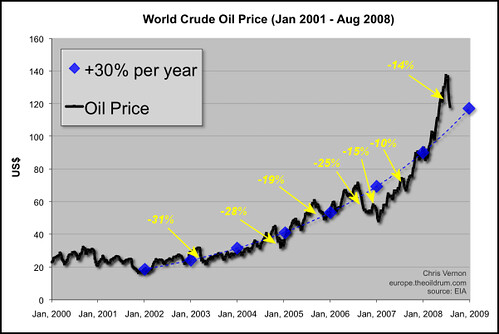
In their report, they point out that oil production FELL by .2% in 2007, despite through the roof prices. In fact, I found on Wikipedia that oil production has been roughly flat since the beginning of 2005.
What does this mean? Normally, when demand falls, the price drops, and then the supply falls. The reason that supply falls is that each oil well has a price per barrel where it makes economic sense to remove it from the ground. In other words, if it took $100 per barrel to pump the stuff out of the ground, why do it if the price is only $90 per barrel on the open market? You'd be losing $10 per barrel that you sold, and you wouldn't last long in the oil business.
Up to 2005, this relationship is solidly in place. You can put the price chart next to the supply chart, and see them moving together. But starting in 2005, the production stops going up; it's as if it hits a limit. The price keeps rising, because the world economy is growing, and it needs more oil to function. Those prices should have caused more expensive barrels in the ground to be pumped up - but they haven't.
Why? My thinking at the moment is that high prices are stimulating exploration and production - the problem is that old production is falling away, as old fields decline. It may be that technology will bail us out of this (new ways of pumping previously unreachable oil), or that new production projects that can meet the world's demand have long lead times. But, at 3.5 years of elevated prices (and counting), my hope there is starting to run thin.
Basically, this is supply and demand. Not greedy speculators and not evil oil companies. This is the result of billions of people around the world emerging from poverty and improving their material life style.
Or, in another fit of irrationality, Congress' newly proposed legislation to undo the Carter reform of pricing oil in a commodities market. They have proposed this to thwart the greedy Wall Street speculators.
Surely, there must be evil lurking somewhere. There must be some scapegoat to pay the price.
But, it isn't to be. I did a little research on my own a few days ago, and convinced myself of what BP has provided in its own Statistical Review of Global Energy 2008.
In their report, they point out that oil production FELL by .2% in 2007, despite through the roof prices. In fact, I found on Wikipedia that oil production has been roughly flat since the beginning of 2005.
What does this mean? Normally, when demand falls, the price drops, and then the supply falls. The reason that supply falls is that each oil well has a price per barrel where it makes economic sense to remove it from the ground. In other words, if it took $100 per barrel to pump the stuff out of the ground, why do it if the price is only $90 per barrel on the open market? You'd be losing $10 per barrel that you sold, and you wouldn't last long in the oil business.
Up to 2005, this relationship is solidly in place. You can put the price chart next to the supply chart, and see them moving together. But starting in 2005, the production stops going up; it's as if it hits a limit. The price keeps rising, because the world economy is growing, and it needs more oil to function. Those prices should have caused more expensive barrels in the ground to be pumped up - but they haven't.
Why? My thinking at the moment is that high prices are stimulating exploration and production - the problem is that old production is falling away, as old fields decline. It may be that technology will bail us out of this (new ways of pumping previously unreachable oil), or that new production projects that can meet the world's demand have long lead times. But, at 3.5 years of elevated prices (and counting), my hope there is starting to run thin.
Basically, this is supply and demand. Not greedy speculators and not evil oil companies. This is the result of billions of people around the world emerging from poverty and improving their material life style.
Tuesday, February 5, 2008
Tuesday, November 20, 2007
ING Direct Buys Universe
I just got an email stating that one of my brokerage accounts has been purchased by ING. Two institutions in a two month period? Coincidence? I think they are out to own my life.
Wednesday, October 17, 2007
Oil Nears Record Highs
You've heard for a few days now that the price of oil has set records in recent days. That's true in a sense, but not in inflation adjusted terms. However, at $91/barrell, the price of oil will exceed its all time inflation adjusted high price, which was set in the 1980's. Many people will remember price controls, lines at gas stations, economic turmoil, rationing, and general energy chaos.
Yet, today, it seems to be taken in stride. I think we can thank the fact that every day our economy becomes less and less energy intensive. Which means, that we are able to produce a dollar of GDP with less and less energy input. This is partly due to the changing nature of our industries, as we move towards more service industry and less heavy manufacturing, but it is also due to technological innovation that has made almost everything from homes to computers to light bulbs to air conditioners more efficient.
And, the optimistic view is that if the price of oil hasn't killed the economy yet, it probably won't, and every day that it is high is another day that adds impetus to diversifying energy sources and making things more efficient. I think all of that is pretty good.
Yet, today, it seems to be taken in stride. I think we can thank the fact that every day our economy becomes less and less energy intensive. Which means, that we are able to produce a dollar of GDP with less and less energy input. This is partly due to the changing nature of our industries, as we move towards more service industry and less heavy manufacturing, but it is also due to technological innovation that has made almost everything from homes to computers to light bulbs to air conditioners more efficient.
And, the optimistic view is that if the price of oil hasn't killed the economy yet, it probably won't, and every day that it is high is another day that adds impetus to diversifying energy sources and making things more efficient. I think all of that is pretty good.
Wednesday, October 3, 2007
Credit Problems Getting Personal
It may seem like I rant about far away things and esoteric topics, but in the last week my life has personally been touched by the credit problems currently going around:
1) My bank failed and was closed by the FDIC (the major bank regulator). NetBank was one of the first internet banks, and I never had much trouble with it, but apparently they bought the wrong sort of mortgages and the government forced a sale. The checking accounts and other liquid assets have been purchased by ING Direct.
2) My mortgage was sold. Not sure what the deal is, but ABN Amro closed down their mortgage servicing web site, and sold my mortgage to Citi Group.
Oh, well. The ING and Citi websites seem better than the others, so I guess its for the best.
1) My bank failed and was closed by the FDIC (the major bank regulator). NetBank was one of the first internet banks, and I never had much trouble with it, but apparently they bought the wrong sort of mortgages and the government forced a sale. The checking accounts and other liquid assets have been purchased by ING Direct.
2) My mortgage was sold. Not sure what the deal is, but ABN Amro closed down their mortgage servicing web site, and sold my mortgage to Citi Group.
Oh, well. The ING and Citi websites seem better than the others, so I guess its for the best.
Monday, October 1, 2007
FPL and solar-thermal energy
Isn't $80/barrel oil grand? Recently, Florida Power and Light announced that they would build a 300MW power plant (that's pretty big) somewhere in Florida. The system uses mirrors to boil water in pipes placed above the mirrors to generate steam. This steam is then stored, and used to drive turbines that generate electricity. The plant will be able to operate for up to 20 hours without sunlight, to help overcome cloudy days and nights.
The costs are competitive, and in some cases cheaper, than coal and natural gas plants. The company to build the plant is Ausra.
You will see a lot more of this.
The costs are competitive, and in some cases cheaper, than coal and natural gas plants. The company to build the plant is Ausra.
You will see a lot more of this.
Ah, normality
So, after all my hand wringing about corporate credit markets, it appears that today, the day that two very large banks announced the damage that the subprime mortgage mess inflicted to their profits, the Dow Jones Industrial Average has set an all time session high. Apparently, fears were a bit overblown, and a major risk seems to be evaporating.
Tuesday, September 11, 2007
China
Hopefully, all of you believe, as I do, that a prosperous China, integrated with the world economy is the best hope for peace and economic growth. However, I've been reading an article in the latest Foreign Affairs Journal about China's environmental problems; and they are manifest. As the author went on about the various horrors, she concluded that the real solutions won't be forthcoming until China reforms some relevant portions of its government. Point taken.
But, I will take it further. I'll say this is a worrisome confirmation of a point that Milton Friedman made. He argued that capitalism and freedom went hand in hand. That capitalism maintained the means of freedom outside of governmental control. For instance, he pointed out that it was very difficult to exercise free speech if the government controls all the radios, televisions, and printing presses.
Recently, it has become a fashionable thing to write that this is a one way street. Freedom may lead to capitalism, but the opposite is not necessarily true. Russia and China are used as the two greatest examples of a society that seems to be embracing an authoritarian, as opposed to democratic, capitalism. And, it has seemed that these two countries have experienced rapid economic growth and improvements in the average person's material standard of living while personal political freedoms remain, or are even further, curtailed.
But, this article on Chinese environmental matters points to what I think is a hidden truth. A capitalist, free market economy is one of the most powerful, dynamic, and unpredictable forces on the earth. And where people have argued that technology developed by such a system just makes it easier to monitor people and restrict their freedoms, I argue that the opposite is the case as well.
A legal system, or a bureaucracy, is a complex and rigid thing, and is even more so when it is not routinely held accountable in elections that vent popular unrest. It may be strong, but it is also brittle. China's environmental problems, as an example, would never have occurred under the former communist economic model, simply because that model was not capable of unleashing the current amount of activity. In this area, and many others, we are now finding that a government of repression is not well suited to adapt to the dynamic needs of a free market. And, further, as the free market enriches the citizens, and technology expands the capabilities of a single individual, the means to seize and exercise political freedom are more and more available.
Here lies the worry: can China survive a revolution? Would it be a velvet one? Or would the government destroy all that has been accomplished to preserve its power? And, if China were derailed, what would happen to a world economic system that has become deeply tied to it?
It's ironic to be worried about democracy, no?
But, I will take it further. I'll say this is a worrisome confirmation of a point that Milton Friedman made. He argued that capitalism and freedom went hand in hand. That capitalism maintained the means of freedom outside of governmental control. For instance, he pointed out that it was very difficult to exercise free speech if the government controls all the radios, televisions, and printing presses.
Recently, it has become a fashionable thing to write that this is a one way street. Freedom may lead to capitalism, but the opposite is not necessarily true. Russia and China are used as the two greatest examples of a society that seems to be embracing an authoritarian, as opposed to democratic, capitalism. And, it has seemed that these two countries have experienced rapid economic growth and improvements in the average person's material standard of living while personal political freedoms remain, or are even further, curtailed.
But, this article on Chinese environmental matters points to what I think is a hidden truth. A capitalist, free market economy is one of the most powerful, dynamic, and unpredictable forces on the earth. And where people have argued that technology developed by such a system just makes it easier to monitor people and restrict their freedoms, I argue that the opposite is the case as well.
A legal system, or a bureaucracy, is a complex and rigid thing, and is even more so when it is not routinely held accountable in elections that vent popular unrest. It may be strong, but it is also brittle. China's environmental problems, as an example, would never have occurred under the former communist economic model, simply because that model was not capable of unleashing the current amount of activity. In this area, and many others, we are now finding that a government of repression is not well suited to adapt to the dynamic needs of a free market. And, further, as the free market enriches the citizens, and technology expands the capabilities of a single individual, the means to seize and exercise political freedom are more and more available.
Here lies the worry: can China survive a revolution? Would it be a velvet one? Or would the government destroy all that has been accomplished to preserve its power? And, if China were derailed, what would happen to a world economic system that has become deeply tied to it?
It's ironic to be worried about democracy, no?
Saturday, September 1, 2007
Some Sunshine
The last several posts have probably painted a fairly bad picture of the markets, and indeed if you've watched the stock market over the past three weeks or so, it has been extremely volatile. But, there are reasons not to be too concerned (and I, in fact, am not overly concerned):
- The global economy has never been so strong. There are always risks (including environmental collapse in China among other things), but all things considered, things are really good out there.
- American profits have been at record levels as a percentage of GDP.
- The economy is stronger than many thought. The second quarter's GDP was revised up to 4.8%, which is a great rate of growth. I think everyone would be thrilled with a consistent 3.5%.
- Only a fraction of 1% of all homes have a subprime mortgage attached to them. Heck, about one in three homes is owned outright.
- We are not yet witnessing a collapse in asset values, the housing prices around the country have been coming down, and inventory is certainly building up, but prices have only dropped marginally. For instance, in Orlando prices have recently begun to tick down a few thousand dollars, but over the last five years, prices are still up about 95%.
- The Federal reserve bank seems determined not to let a panic set in for the commercial paper markets, but rightly, I think, they also seem determined not to bail out people who made poor decisions.
- People aren't stupid, and therefore people are getting out of their adjustable rate mortgages that are resetting to higher interest rates for a fixed 30-year mortgage, which a qualified buyer can still get for around a 6.5% interest rate - which really isn't bad.
Credit Woops - Part 5
So, who bought all these asset backed securities? Lot's of people, but most notably, hedge funds. Hedge funds are just like mutual funds, except they usually require large amounts of money to join, have relatively few investors involved, and don't have to say up front what their investment strategy is (in other words, they can do pretty much whatever they think will make money). They play an important role in the financial system, but they often times swing for the fences since the hedge fund manager can be paid a percentage of the assets gained - double $300 million dollars for investors, and a 5% commission is looking pretty good.
Hedge funds, pension funds, and foreign banks all bought various flavors of these asset backed securities for their varying mixes of risk and reward. Those institutions that bought too much of the bad stuff are going to have to take a hit. And that's how the mortgage in Miami can give a bank in France some nervous moments.
There is one other side to the whole story, and that is that a similar liquidity boom was happening with respect to loans to companies, also called the "commercial paper" market. The same story pervades there. Quickly, typically when a bank makes a loan to a company, it requires "covenants", which are simply benchmarks it requires the borrower to maintain. These requirements help the lender know that their borrower is sound, and will be able to make interest payments. But, in all the hubbub, new "covenant-lite" loans were issued, and companies didn't have to show how they could pay it back. One telling quote I read recently was a lending manager saying that he didn't meet with a borrower over a $25 million loan because "it wasn't worth the meeting time". Not good.
As a result, lenders are now nervous about the loans they have already made, and don't really want to make many new ones. And here is the serious problem: without freely available credit our economy doesn't function, because many companies take loans to make large investments that keep their businesses running. If they can't make those investments, they can't hire people, they can't compete as well, and they can't meet demand.
Put the rising defaults on mortgages which are now connected to the world financial system with the lock-up in the commercial paper markets, and a lot of people are very worried.
Hedge funds, pension funds, and foreign banks all bought various flavors of these asset backed securities for their varying mixes of risk and reward. Those institutions that bought too much of the bad stuff are going to have to take a hit. And that's how the mortgage in Miami can give a bank in France some nervous moments.
There is one other side to the whole story, and that is that a similar liquidity boom was happening with respect to loans to companies, also called the "commercial paper" market. The same story pervades there. Quickly, typically when a bank makes a loan to a company, it requires "covenants", which are simply benchmarks it requires the borrower to maintain. These requirements help the lender know that their borrower is sound, and will be able to make interest payments. But, in all the hubbub, new "covenant-lite" loans were issued, and companies didn't have to show how they could pay it back. One telling quote I read recently was a lending manager saying that he didn't meet with a borrower over a $25 million loan because "it wasn't worth the meeting time". Not good.
As a result, lenders are now nervous about the loans they have already made, and don't really want to make many new ones. And here is the serious problem: without freely available credit our economy doesn't function, because many companies take loans to make large investments that keep their businesses running. If they can't make those investments, they can't hire people, they can't compete as well, and they can't meet demand.
Put the rising defaults on mortgages which are now connected to the world financial system with the lock-up in the commercial paper markets, and a lot of people are very worried.
Wednesday, August 29, 2007

Tuesday, August 28, 2007
Credit Snafu - Part 4
Alas, these broken mortgages... where did they go? Firstly, the mortgage brokers that initiated the mortgages promptly sold them to large banks. These banks, of course, had no desire to burden their own balance sheets with risky mortgage paper, so they had to sell them also, but who wants to buy a subprime loan with a high risk of default? There are those with a risk appetite but not enough to consume all of the loans
A solution was devised. The banks can create what are called Collateralized Debt Obligations, or CDOs. How do these work? First, you get together a whole lot of subprime loans. Then, you sell shares of these loans to other people. But, here is the trick, not all shares are created equal. Some are "senior" shares, and others are "junior" shares. What is the difference? When one of the many subprime loans defaults , it is assigned to the most junior shares, and when a mortgage payment comes in, it is first assigned to the senior shares. These share levels are called "tranches", and let's suppose there were five evenly sized tranches for the purposes of an example. If 40% of the subprime mortgages in the CDO defaulted, only the two most junior tranches would feel any pain. The three most senior ones would continue to get paid, and would not have any loss of assets. For this reason, the senior tranche could get a AAA credit rating, while the most junior tranche became known as the equity tranche, or in Wall Street lingo, "toxic waste".
To close, let's look at the reasons why this was done. Because a AAA credit rating has less risk, it can sell for a higher price (as was discussed in Part 1 post on risk and reward). Since a subprime loan is risky, it can be bought for a lower price. The difference between these prices can be profit.
Of course, that leaves you holding some "toxic waste". What to do? Buy insurance! This is called a credit swap. A bank can create a AAA quality CDO tranche, sell it for profit, and then pay someone else to absorb the losses if the toxic waste experienced defaults (like when you pay someone else to cover your losses in the case of a house fire).
And, since we all know that house prices go up 15% a year forever, that insurance can be bought very cheaply (wink, wink).
A solution was devised. The banks can create what are called Collateralized Debt Obligations, or CDOs. How do these work? First, you get together a whole lot of subprime loans. Then, you sell shares of these loans to other people. But, here is the trick, not all shares are created equal. Some are "senior" shares, and others are "junior" shares. What is the difference? When one of the many subprime loans defaults , it is assigned to the most junior shares, and when a mortgage payment comes in, it is first assigned to the senior shares. These share levels are called "tranches", and let's suppose there were five evenly sized tranches for the purposes of an example. If 40% of the subprime mortgages in the CDO defaulted, only the two most junior tranches would feel any pain. The three most senior ones would continue to get paid, and would not have any loss of assets. For this reason, the senior tranche could get a AAA credit rating, while the most junior tranche became known as the equity tranche, or in Wall Street lingo, "toxic waste".
To close, let's look at the reasons why this was done. Because a AAA credit rating has less risk, it can sell for a higher price (as was discussed in Part 1 post on risk and reward). Since a subprime loan is risky, it can be bought for a lower price. The difference between these prices can be profit.
Of course, that leaves you holding some "toxic waste". What to do? Buy insurance! This is called a credit swap. A bank can create a AAA quality CDO tranche, sell it for profit, and then pay someone else to absorb the losses if the toxic waste experienced defaults (like when you pay someone else to cover your losses in the case of a house fire).
And, since we all know that house prices go up 15% a year forever, that insurance can be bought very cheaply (wink, wink).
Thursday, August 23, 2007
Credit Mess - Part 3
Of course, all of the problems that are being experienced in the lofty world of high finance come from very concrete root problems. So, this time, I wanted to discuss the very foundation of the recent troubles.
After 2001, the Federal Reserve lowered interest rates to 1%. This is ridiculously low, since inflation runs around 2.5%. Now, a lower interest rate could mean a lower house payment, but many people buy houses by asking the question, "How much house can I afford?" And they answer the question in terms of a monthly payment, which means that with a lower interest rate the same monthly payment can by more. So, people spent more, and more people spent.
This surge in demand, and the ability of people to pay more for a house, started a housing boom. A few years in, houses were going up faster and faster. People began to buy investment properties, either to rent or to "flip" (which is when you sell after holding for a short period of time), which added even more demand and drove prices even higher.
When people started to worry that houses historically have pretty much just kept up with inflation, and might be overvalued, others pointed out that the median U.S. house price hadn't fallen since the 1930's in the Great Depression. We weren't in a depression, so the party kept on going.
Everyone was getting rich. The mortgage brokers, the folks who actually help you fill out the paperwork and find a lender for you, were getting lots of fee income. So were the realtors, and the appraisers, and the inspectors, and everyone else involved.
Soon, the boom had exhausted the "normal" market, everyone who wanted a house had one. Mostly the folks who were left were not the sort that usually get loans, but after a boom period, expectations rise. The extraordinary becomes the routine, and there is great pressure to keep the good times rolling. What to do?
The list of things done ranges from stupid to fraudulent. Among them were loans called "NINJAS", which stands for "No INcome Job or Assets". Some lenders asked borrowers to sign the bottom of blank paperwork, and the numbers for income, house value, etc. were filled in later so the loan would go through. People were given loans not just for the price of the house, but for 120% of the price of the house, because it would surely go up another 20% and people "need" cash to furnish their homes. People signed up for adjustable rate mortgages (or ARMs) which start out with really low teaser rates, but a few years later "reset" to a much nastier one (which is happening now). And, appraisers valued homes well above their real value to justify larger loans.
All this is just the beginning of the story, because these irresponsible behaviors led to a whole host of other problems that I'll discuss shortly.
After 2001, the Federal Reserve lowered interest rates to 1%. This is ridiculously low, since inflation runs around 2.5%. Now, a lower interest rate could mean a lower house payment, but many people buy houses by asking the question, "How much house can I afford?" And they answer the question in terms of a monthly payment, which means that with a lower interest rate the same monthly payment can by more. So, people spent more, and more people spent.
This surge in demand, and the ability of people to pay more for a house, started a housing boom. A few years in, houses were going up faster and faster. People began to buy investment properties, either to rent or to "flip" (which is when you sell after holding for a short period of time), which added even more demand and drove prices even higher.
When people started to worry that houses historically have pretty much just kept up with inflation, and might be overvalued, others pointed out that the median U.S. house price hadn't fallen since the 1930's in the Great Depression. We weren't in a depression, so the party kept on going.
Everyone was getting rich. The mortgage brokers, the folks who actually help you fill out the paperwork and find a lender for you, were getting lots of fee income. So were the realtors, and the appraisers, and the inspectors, and everyone else involved.
Soon, the boom had exhausted the "normal" market, everyone who wanted a house had one. Mostly the folks who were left were not the sort that usually get loans, but after a boom period, expectations rise. The extraordinary becomes the routine, and there is great pressure to keep the good times rolling. What to do?
The list of things done ranges from stupid to fraudulent. Among them were loans called "NINJAS", which stands for "No INcome Job or Assets". Some lenders asked borrowers to sign the bottom of blank paperwork, and the numbers for income, house value, etc. were filled in later so the loan would go through. People were given loans not just for the price of the house, but for 120% of the price of the house, because it would surely go up another 20% and people "need" cash to furnish their homes. People signed up for adjustable rate mortgages (or ARMs) which start out with really low teaser rates, but a few years later "reset" to a much nastier one (which is happening now). And, appraisers valued homes well above their real value to justify larger loans.
All this is just the beginning of the story, because these irresponsible behaviors led to a whole host of other problems that I'll discuss shortly.
Subscribe to:
Posts (Atom)

